
June 18, 2026
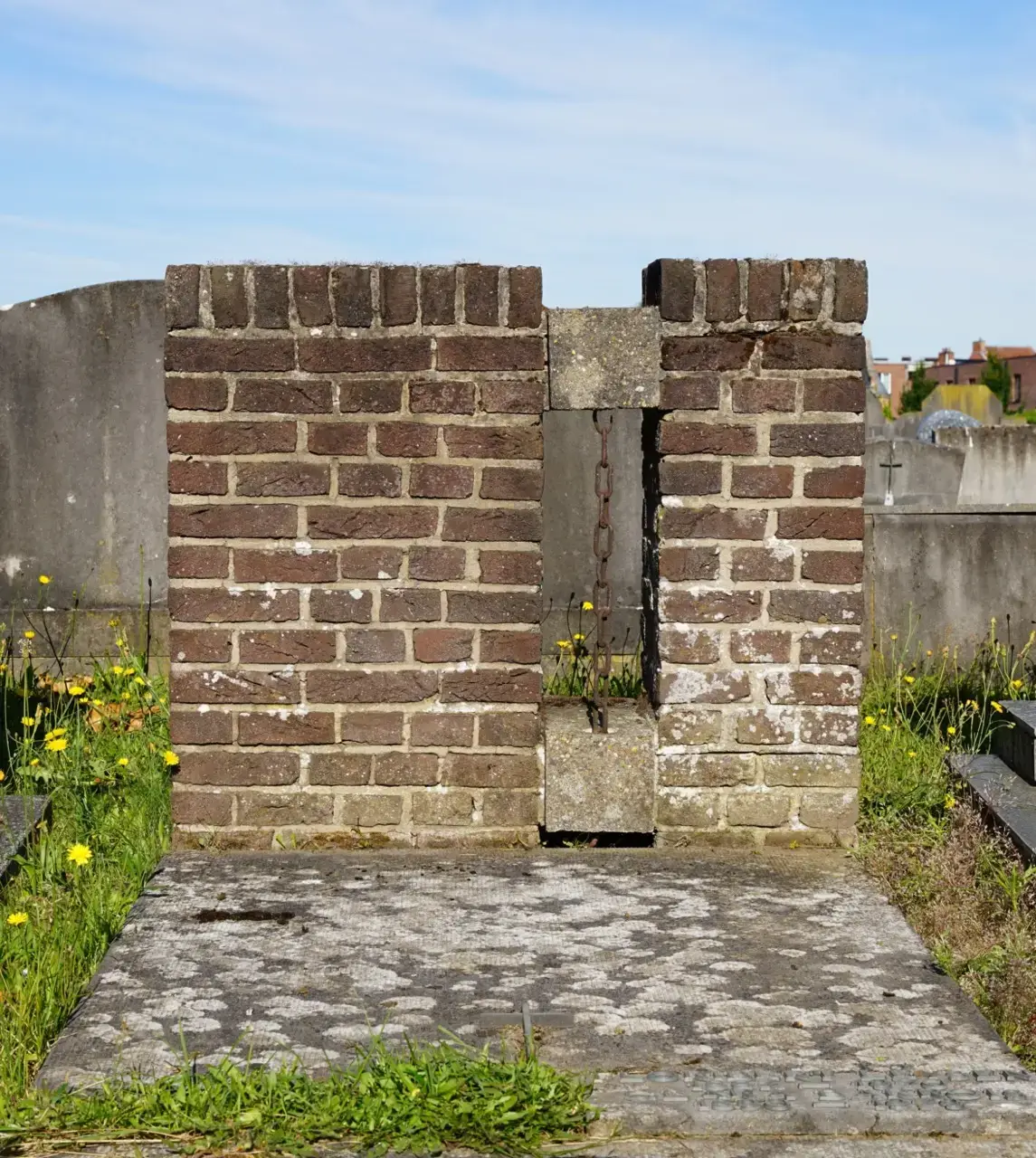
A funerary monument that bears a surprising resemblance to the architectural language of Atelier Carli Vanhout – Paul Schellekens & Ass.
Among the many classical funerary monuments in the historic cemetery of Turnhout lies a strikingly sober yet powerful composition in brick, concrete, and steel. A headstone that, despite its modest scale, possesses a remarkable architectural character.
The grave of Floribert Leysen (1887–1970) and Clara Barrois (1890–1979) immediately draws attention due to its unusual design. No traditional bluestone or richly elaborate ornamentation, but a brutal, sleek composition of dark brick volumes, raw concrete elements, and a simple metal chain. An almost sculptural intervention, built from pure materiality and proportions.
This special find was discovered by Jef van Doninck of Erfgoed Noorderkempen. For those familiar with the oeuvre of Atelier Carli Vanhout – Paul Schellekens & Ass., the image feels surprisingly recognizable.
The similarities with the architectural language of Carli Vanhout’s studio home are striking:


Even the central opening between both brick volumes is reminiscent of the way modernist architects defined spaces not only through mass, but also through void.
The metal chain forms a particularly interesting detail. It does not appear merely decorative, but is an integral part of the composition — a typical modernist principle where construction, function, and aesthetics coincide.
Whether the monument was actually designed by Carli Vanhout or by Atelier Carli Vanhout – Paul Schellekens & Ass. has not yet been confirmed. Chronologically, however, it would be perfectly possible. The period in which the grave was created coincides with the active years of the studio in Turnhout.
Furthermore, it was not exceptional at that time for architects to also design funerary monuments for local families, entrepreneurs, or acquaintances. Certainly within the context of the Turnhout School, where architecture often extended into interiors, furniture, art applications, and commemorative architecture.
What makes this monument particularly special is the naturalness with which architecture is present here. Not as a monumental gesture, but as a carefully constructed composition of materials, proportions, and details.
Cemeteries often represent a forgotten chapter within architectural history. Yet they are rich in hidden modernism: funerary monuments in which the formal language of their time remains subtly present.
This grave in Turnhout shows how modernist ideas found their way into small, intimate architectural interventions beyond homes and public buildings.
Perhaps this monument is not a coincidental kinship, but a silent echo of the same architectural culture that also shaped the homes and buildings of the Turnhout School.
A modest headstone — but with a remarkably strong architectural presence.

After photographing the grave, I paid a brief visit to the family grave of Jozef Schellekens. A short stop, but at the same time a modest tribute to the first generation. To the man who helped lay the foundation for an architectural tradition that still lives on today. Among the silent witnesses of the past, it became clear once again how strongly heritage, family history, and architecture are intertwined.
Perhaps it is precisely such moments that remind us that architecture lives not only in buildings, but also in memories, stories, and places of remembrance.